
Teamwork is it, nowadays. Well-functioning teams are an asset to any organisation.
If an organisation is to stay sound or become even better, staff – and, therefore, teams – will have to meet increasingly higher demands. Teams should continually reinvent themselves and make determined efforts to improve. This requires considerable and positive energy. Individual team members have physiological energy; teams, on the other hand, have social energy: team energy. There is rising awareness that social energy is omnipresent, albeit not always of adequate quality and to the required extent. Good social energy is not a matter of course. Within the school of the positive organisation, the interest in studies into positive patterns within organisations is increasing –without disregard for the negative patterns or dysfunctions that can also be identified, obviously. Team energy ties in with this.
Since the 1970s, researchers have been focused primarily on the physiological energy of individual staff members. The shift towards collective energy in recent years has led to a threefold division: individual energy, team energy and organisational energy. Research into team energy is scarce. We know very little about energy within teams, how it emerges, how great it is, how it develops and how it may be influenced. The study into team energy described here, intended to fill a gap in this “research void”. It looked for an answer to the following question: “How can team energy be influenced?”
Research design
The aim was to conduct a study that combined the strengths of both quantitative and qualitative methodologies. These are described in Chapter 2. In broad outline, it was a longitudinal study involving a mix of a multiple case study, action research and quantitative research methodologies. Cluster and regression analyses were conducted in order to cluster the measured energy values, identify development patterns in the level of energy and trace the correlations between the dependent variable of team energy and a number of independent variables (interventions and environments). In a multiple case study, the teams themselves are also heard. Teams are unique; they each have their own story. Ignoring this uniqueness would detract from the study’s objective of studying teams in their natural habitat and trying to understand them better in order to be able to contribute to the intervention and change the theory pertaining to the influence of energy in teams. Approximately 90 teams in 6 different public organisations were studied during a period of 2.5 years, during which a standardised survey was conducted with each team three times. The survey was used to map out the team energy experienced by each team. The focus of the study is on influencing the teams’ energy through the application of interventions.
What is team energy?
Team energy is regarded as “the outcome of a social, rechargeable resource that people employ (during processes of collaboration, social interaction and working in close vicinity) as well as experience in this collaboration in order to get themselves and their direct team colleagues going on their way towards a balance between the work climate and team results that is profitable to the team.”
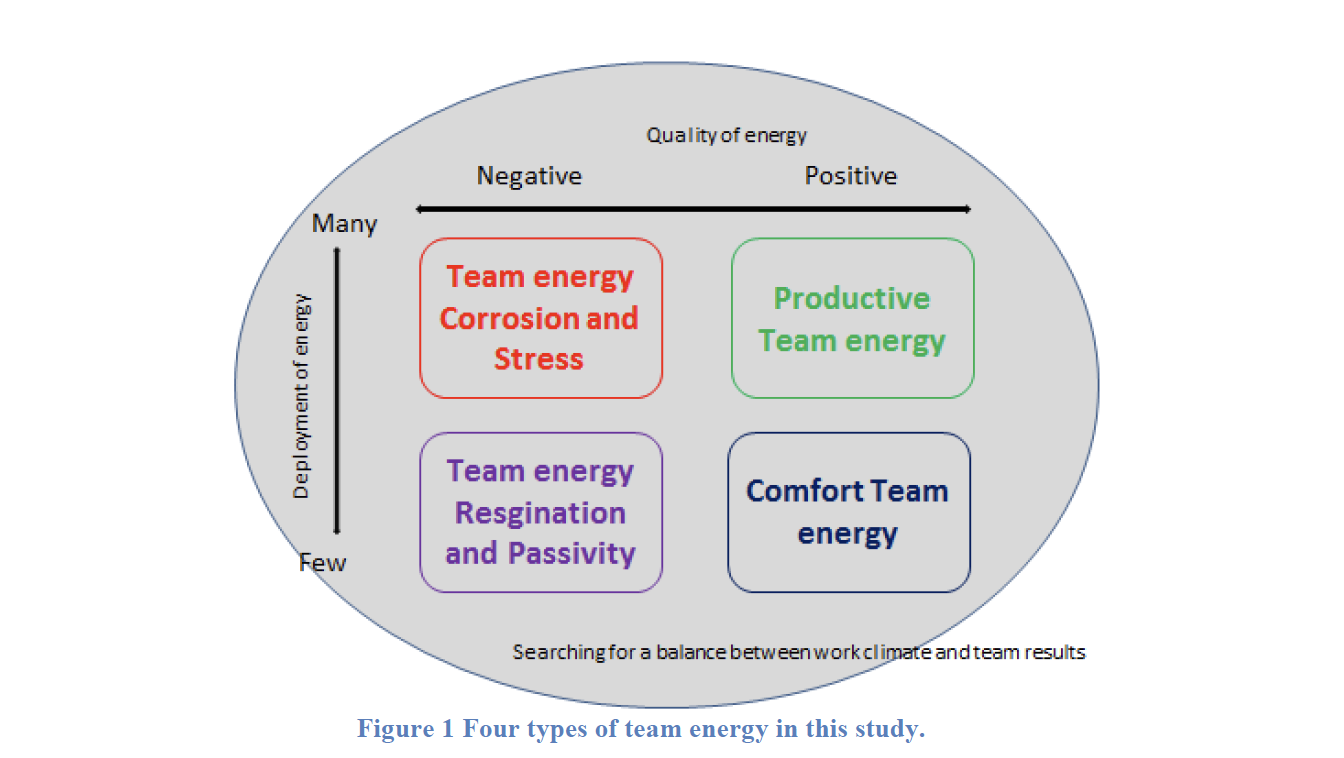
Following Bruch & Vogel (2011), team energy is viewed as a powerful and, at the same time, soft team factor. According to Schiuma et al. (2007) and Bruch & Vogel (2011), team energy has an individual, synergetic and emergent component. Team energy is operationalised along two dimensions – “deployment of energy” and “quality of energy” –resulting in 4 team energy types: productive team energy, team energy resulting from a shared comfort zone (‘comfort team energy’), team energy based on resignation and passivity, and team energy based on corrosion and stress. The investigation into the energy in the teams used the ideas of pragmatism, social constructivism and the positive organisation. The study was primarily explorative.
Apart from team energy, this thesis also describes 3 key concepts on the basis of more recent literature. The first of these concepts is ‘teams’. Teams are clearly recognisable groups of people consisting of at least 4 members and sharing a common goal or interest. It is the dependencies in duties and/or social interactions that also make the members regard themselves as a team.
Teams are seen as open systems. The environment applies as the second key concept. This environment is divided into an internal and an external environment. The internal environment is regarded as the shared beliefs, experiences and perceptions on whatever the team members believe to be the team’s ‘fixed’ attributes and/or characteristics. The external environment comprises the attributes and/or characteristics, or any changes in these that the team members identify as not applying to the team itself and which might be the grounds for the team’s idea or need of change. This is where events occur and decisions are made. Such changes take place in the external environment. Decisions refer to explications of the choices made. Decisions can also be non-decisions: refraining from making a decision when the situation warrants it. Both events and (non-) decisions fall outside of the teams’ direct sphere of influence. Events can be external or internal; they occur in the internal environment without the team members being able to exert any influence.
The third key concept is interventions, which are viewed as a single or series of applied change activities aimed at either increasing the team’s effectiveness or at a ratio between the four distinctive team energy types that is more favourable to the team. Interventions can be applied to an individual team member, in the interaction between several team members, or at the level of the team as a whole. The concepts are described separately, in Chapters 3 to 6. In Chapter 7, they converge and the first partial questions are answered.
The use of the survey
Prior to the analyses of the outcomes of the surveys, the usability of the survey as a research instrument was established (Chapter 8). The study followed a multilevel approach (Cole et al., 2012, Klein & Kozlowski, 2000). Three levels applied. The first was the level where the data were collected: the level of the individual team members. The team level came second, and the organisational level was the third. The latter is the level where case contagion might arise (Rosenthal & ‘t Hart, 1992; Morrow, 1983).The analysis led to the conclusion that this had not occurred. For the purpose of aggregating the individual questionnaires according to the level of the beliefs shared within teams, the intraclass correlation ICC (1) was determined (ICC (1) = 0.20 (ANOVA, F (86; 740) = 3.01, p < 0.001 (95% CI, 0.13 < ICC < 0.28)). It was concluded that, going by the respondents’ judgements, substantial differences in energy levels existed between the teams. The degree of agreement met the statistical standard that is usually applied here. Since the study involved teams of different sizes, the ICC (k) was also established (ICC(k) = .70, using the Spearman-Brown formula (Klein & Kozlowski, 2000)) for an average team size of 9.5. The ICC (1) and ICC (k) values confirmed the reliability and validity of the team energy construct. The construct could be used to express the team energy experienced and the questionnaire was a suitable instrument to map out the multilevel phenomena.
Cluster analysis and recognising energy patterns
The teams’ survey results were clustered through a two-step cluster analysis (SPSS version 23). Clustering causes correspondences in the energy values between the teams within one energy cluster to be greater than the energy values in others. The independence between the four distinguished energy types as described by Bruch & Vogel (2011) was found. These energy types occurred simultaneously. The study used a classification into 8 energy clusters.
The 8 recognised energy clusters were positioned in relation to one another. Their interrelational positions were determined through a field consultation; this gave them their relevance in the issue as to whether or not team energy can be influenced.
Interrational positions of energy clusters (form ‘worst’ to ‘best’): 1, 3, 2, 4, 5, 7, 6, 8.

Apart from the pattern towards more positive energy, the study also looked into the teams’ courses along the 8 distinguished energy clusters. The 8 energy clusters related to each other in 3 groups of 3, 3 and 2 clusters, respectively. A first group of energy clusters (referred to as ‘leaving’) showed teams that were actually ‘moving away’ from them. These were the teams with a great amount of negative energy. These teams were primarily moving in the direction of the second group of ‘searching’ energy clusters. Typical for this group was their teams’ great agility or quest for a new balance. Teams that succeeded to move from this group of energy clusters into the final group of ‘stayers’ joined a group of energy clusters that, according to a pre-determined positioning, could be regarded as the best. Once a team arrived in this group, the chances that they stayed there was great.
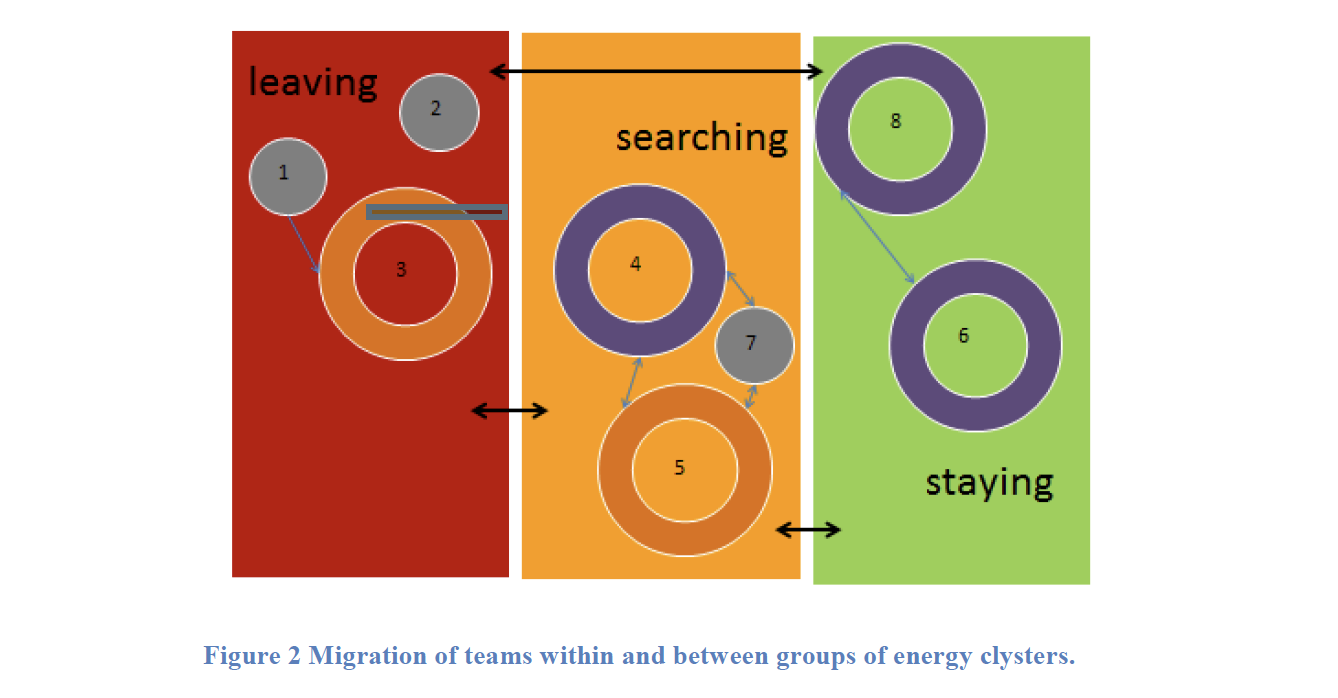
The cluster analysis outcome and the energy pattern that was found demonstrated that team energy varied over time. Teams each developed their energy at their own speed. The courses were the same, but the speed varied.
Influencing team energy
Chapter 11 describes the search for correlations between the application of interventions, the occurrence of events, and decision-making and changes in team energy. To this end, regression analysis techniques were used. Data about interventions, events and decisions (IEDs) were collected through interviews with the team members. The interviews were tape-recorded, transcribed and thematically coded. The coding made it apparent that approximately 44% of the applied interventions were interventions in the system and structure. In almost 80% of the IEDs, they bore on the entire team. Almost 40% of the IEDs involved power and influence (coded as ‘yellow’ in accordance with the colour theory of De Caluwé & Vermaak, 2006). ‘Red’ (consideration of the HRM aspects and the individual involved in the change) played a role in approximately 33% of the IEDs. Interventions in a way in which particular attention is paid to learning and reflection (green) and/or self-organisation (white) appeared to be a rare occurrence for the teams investigated.
Team energy increased over time. The average increase between the 0 and 1 measurement amounted to 0.34 (measured on a scale of 0-5, sd .375, n-71).When corrected for IEDs, there was an average team energy increase of .675 (scale 0-5, T01, n=71). IEDs had a negative impact on the team energy increase.
Three regression analyses were conducted in order to disclose the correlations between the independent variables (intervention type, method and level) and team energy, while controlling for team size as well as whether it concerned an executive team or not.
It was found that experienced energy correlated negatively with all the types and methods of intervention. Interventions aimed at systems and structures correlated positively with the team size as well as with interventions focused on the appreciation of differences and conflict management. External events and final decisions often went together. Internal events correlated positively with interventions intended to step in and get on with things.
The regression analyses did not show a significant, specific correlation between certain intervention types and team energy. If there was any correlation, it was merely in the short term; in the long term, they disappeared. As for the intervention methods, it was found that, on the one hand, the yellow method was applied the most and, on the other hand, this method had a negative effect on the experienced energy – both in the short and long term. As regards the level at which the interventions were applied, no significant correlation was established.
Yet, interventions matter. When the regression analysis also included the total of interventions applied, a negative effect on the experienced energy was found. However, this effect was less negative than the effect that was established when all the interventions, events and decisions were included in the analysis. Interventions seemed to have a dampening effect on the negative impact of events and the decisions made on team energy.
How can these outcomes be explained?
The findings from the regression analysis are striking, sometimes even counter-intuitive. Possible explanations were sought along three different directions. Apart from (1) mistakes, shortcomings and limitations arising from the investigation itself, different (2) explanations may also be found in content issues. A third clarification may be sought in the emergent component of team energy (Schiuma et al., 2007).
A first possible explanation concerns the research period. Cummings & Worley (2009) point out that the effects of interventions may only become visible after a longer time. Although this explanation is possible, its validity can be disputed. After all, the teams were studied over a period of almost 2.5 years, which can be expected to be long enough for any positive effects on team energy to emerge. A contraindication for challenging the validity of this explanation can be found in the interventions’ decreasing negative effect on team energy over time. The study confirmed this.
A second explanation might be unfortunate timing. All the participating teams were ‘going through a tough patch’. They were dealing with continuous cutbacks and changes. This might well have led to the situation that additional IEDs were, or had been, simply too much or were even overshadowed by the prevailing mood. The teams might not have been able to ‘take any more’ or their spirits were ‘broken’. If so, any intervention would mainly be a disruption in already hectic times and have an opposite effect.
The applied interventions were largely aimed at systems and structures. Teams have rules, procedures and systems, etc. These ensure order. Interventions that bring additional systems and structures (Boonstra, 2011) or are applied in a ‘yellow’ or ‘blue’ way (Caluwé de & Vermaak, 2006) come on top of this existing order. This means that even learning will be structured and imposed. Chances are, therefore, that the added structure puts learning on an even lower backburner. What remains are primarily the things that ‘need to be done’ and do not raise people’s energy.
A third explanation was not so much the timing itself but rather a case of it being ‘too much in too short a time’ for the teams. The smaller increase in their team energy was not due to the circumstances, but rather to the number of interventions applied. Within a period of approximately 6-9 months, each team faced 6.65 interventions. This might have been too much, the more so if this is an annual occurrence.
A fourth possible explanation might be that the interventions were not ‘powerful’ enough or might not have been followed up, so that their impact did not have the intended effect. Boonstra (2011) discusses the
generation of energy for change. Power interventions (Boonstra, 2011) can make room for renewal. It could be that the interventions were not applied with enough power so that no, or not enough, room was created. In both cases, the interventions ‘fall flat’.
Aside from the fact that many – perhaps, on average, too many – interventions, events and decisions occurred, the relationships between them might also hold an explanation. It might, in fact, be the lack of such relationships. A few teams were dealing with an intervention plan. For most teams, change took place without a predetermined objective (Caluwé de & Vermaak, 2006). Team members lost track and no longer knew which change they were actually dealing with or what they were to achieve. This method of change costs energy.
This study used the idea of the positive organisation. This is not to say, however, that the same went for the interventions that were applied. Interventions are implemented when there are problems to be solved, if there is something to tackle. In short, interventions arise from negative issues; this is not in keeping with the central idea of the positive organisation. The teams took the fact that an intervention was applied as a correction of a shortcoming rather than a proactive, preventative or ampliative mode. Corrective or reparative interventions undermined the self-esteem within a team. There was a negative bias against interventions.
Contagion and emergent processes
The study concentrated on visible, noticeable interventions, events and decisions based on the assumption that those influence team energy. This was indeed confirmed, but there are also other influential processes that went unnoticed by the team members. Working in teams can give energy when their members like working together or realise achievements that earned appreciation. Energy is transformed and enhanced by interactions between team members. Those interactions evoke social psychological processes such as “emotional contagion” (Barsade, 2002), “organizational sensemaking” (Maitlis, 2005) and “behavioral integration” (Bandura, 2001) and in their turn contribute to the emergence of team energy. According to Collins (1993), people like working in healthy teams with positive energy, but that is not the only thing. People also work on teams. This happens out of view, implicitly, possibly even subconsciously. Team members are, in fact, continually busy improving their team’s energy; they do, however, not recognise or describe this as an intervention.
Contrastive case analysis: Teams with a great energy leap
In addition to the regression analysis, an elaborative qualitative and contrastive case analysis was conducted for 11 teams. The concept of the energy leap was introduced as a way of expressing the energy change between measurement moments. The teams with the greatest energy leap, either positive or negative, were examined more closely. Within a period of 6-9 months, a great energy leap may take place. A leap may be temporary, but it can also lead to a new and long-term situation at a different energy level.
In the teams with a negative energy leap, this leap seemed to be caused by events and/or decisions. The period when performance was at a lower level appeared to be a predictor for the duration of recovery. Teams with a long-term recovery period appear to be mostly and primarily in need of interventions that helped reach closure to the past.
Teams with a positive energy leap ‘framed’ the events and/or decisions differently. These did not have a cramping or rigidifying effect; they actually led to the employment of extra energy. Teams emphatically took charge of themselves, organised their own collaboration and task dependency, set their own boundaries and continually focused on the customers. The focus on their mutual manners was an essential aspect in the interventions applied.
Not all the teams made an energy leap – for various reasons. Some were already working at a high energy level or there were strong patterns and the identification with the ‘here and now’ prevailed. In teams performing at a lower energy level, the non-occurrence of an energy leap might have been related to the need to uphold the current situation, even though it is not a pleasant one.
Theory on the exercise of influence on team energy
Chapter 14 culminates the outline of a theory on the exercise of influence on team energy –from a social-constructionist and pragmatic approach: there is no single reality and if it works then it is true. The literature reviewed, as regards social energy, is summarised in 5 concepts/constructs. They are about team behaviour under the influence of emotional stimuli and self-image, team energy that is running out, increasing or recovering, sources of contagion in a social climate, full presence within a team, task dependency, and shared
beliefs. Existing theoretical insights and the results from the field study were collated and converted into assumptions as a preview on the described theory on the exercise of influence on team energy. Following the reasoning behind the concept of Positive Organizational Scholarship (POS), this study focused primarily on positive processes.
In keeping with the assumptions, specific characteristics of the acknowledged 8 energy clusters were identified on the basis of case descriptions. The descriptions were arranged from the worst to the best energy cluster. The order was determined via the field consultation referred to.

The theory’s point of departure is a supposed reciprocal relationship between energetic processes within the teams’ work environments and team energy. Its focus lies on the dynamics in the experienced team energy and their interaction with energetic processes. Teams do not only deliver functional, but also social achievements. The degree to which functional achievements can also be delivered in the longer term is highly influenced by the quality of the teams’ social achievements. Both the internal (within the organisation) and the external environment (Kahn, 1992) exercise influence on the team.
Stimuli as a form of output from the energetic processes are basically individual stimuli linked to individual team members. Team members judge their own mental and physical state. People subconsciously ‘read’ their own emotions; when experienced emotions are ‘sabotaging’, their preparedness to put energy into the work will decrease. There is a distinction between synergetic stimuli and emergent stimuli. This distinction is made so as to emphasise the difference in nature between the two. For both, it applies that their occurrence cannot be controlled. It is through contagion that stimuli become collective – the team’s. In their turn, stimuli stored as team energy influence the course of the energetic processes. Teams are responsible for, and have ownership of, team energy; the individual team members are the ones who employ it. Stimuli are charged. Positive and negative stimuli exist alongside one another and can occur simultaneously. An overdose of positive stimuli (in number or intensity) results in a recovery or an increase of team energy. The recovery of team energy implies a disruption in the energetic processes, but, as such, more positive – or less negative – stimuli emerge. For a team that strives towards the delivery of functional and social achievements in the long term and at a high level, the recovery of energy is as valuable as its usage.
Chapter 12 discusses the central research question: “How can team energy be influenced?” Teams can do so in at least 3 ways. The first is the organic and autonomous way. It is a form of continuous change (Farjoun, 2007) without it being regarded as change by the team members. Work is change and change is work; these notions can be distinguished in concept, but in practice they are inseparable. The second is the application of interventions. Interventions can be of a curative, preventative or ampliative nature. “Sick patients want to heal, but you do not have to be sick to want to get better.” The third way is by changing the amount of converted potential individual energy. In other words: work harder or less hard. Every team has an active ‘system’ of sharing and reflecting on experiences. Shared beliefs give meaning to the stimuli experienced in the execution of the energetic processes. Shared beliefs determine the (positive or negative) charge of the stimuli.
The exercise of influence on team energy seemed to run according to a pattern, which comprised 8 positions in this study. The pattern was, in keeping with the POS concept, normative in nature (Cameron & Spreitzer, 2012). A team’s position within the pattern was taken as a predictor for the development of team energy. Depending on this position, the IEDs were primarily either disruptions of energetic processes or, in fact, chances and opportunities for the team to grow further to a higher level of functional and social achievements. High energy teams were teams where the latter enhanced one another, where team energy was directed or ‘channelled’, and where recovery, contagion and the sharing of beliefs received attention. They were teams that knew that slowing down might actually speed things up. They were also teams that let actions speak louder than words; they lived by them.
Reflection and recommendations
This dissertation concluded, as chapter 13, with a reflection on the research design and the outcomes it yielded. Conducting a study that combines quantitative and qualitative components proved to be complex in practice. It required continuous heed of the dividing line between whatever was deemed desirable for the purpose of the study and practical feasibility, or not, on the part of the researcher. A study on this scale emphatically demands adequate research capacity. A study in and around teams also requires that the researcher is able to cope with the tension between researching and advising or intervening.
From the team energy perspective, the study intended to acquire a better understanding and knowledge and add insight to intervention theory. Teams are complex; they do not simply divulge their secrets. Despite the many studies into teams conducted over the years, this investigation has provided new insights and leads for further research. There is quite a lot we do not know as yet. Team energy as an aspect within the school of the positive organisation is a new and virgin territory. The study clearly confirmed the assumption that team energy varies over time – and can do so quite rapidly. It also made clear that interventions, however well-intended, do not always work out well. Worse still, the study actually indicates that we had better be very reserved in the application of interventions. It also found that interventions in the system and structure are applied the most. Only a very modest number of interventions focused more on learning and reflection. This throws a different light on the implementation of interventions and the changing of teams. The concept of the positive organisation is in full development. Team energy is one of its aspects. More research is required if the great potential at the bottom of energy is to be realised. Research in other organisations is also advisable in order to demonstrate the usability of the construct of team energy, but also under different circumstances; it might well be that interventions yield positive effects on team energy if timing is less of an issue. Additional research into the usability and applicability of the theory on influence, as developed in this study, is also desirable. It is a theory that would benefit from further exploration and concretisation. Last but not least, it is advisable to initiate more collaboration between scientists, consultants, interventionists and team members in different organisations. Teams are the vehicle for the organisations of the future. We may have learned quite a lot about them, but there is an even greater amount still to be discovered.
Van der Zwan, 2017©
