
Do you recognize this? Despite all the time management tools, workshops, and handy apps, you still find yourself procrastinating. What’s often behind this is a lack of real priorities. Meanwhile, social media, endless messages, and spontaneous calls create constant noise. You’re running from one thing to the next, reacting to everything coming your way, and losing control over your own day. You’ve become part of someone else’s agenda.
How do you break that pattern? The answer is simple: set priorities and create focus. But do it with an eye on the energy and dynamics within your team. Because prioritizing isn’t just an individual skill – it’s also a team competence. By charting the course together, you create calm, clarity, and space for what truly matters.
Eisenhower’s Quadrants as a Compass for Teams
A classic model that helps with prioritizing comes from former U.S. President Dwight Eisenhower. It was later popularized by Stephen Covey. The foundation is just two questions: Is it important? And is it urgent?
These questions create four quadrants you can use to categorize all your tasks – individually and as a team:
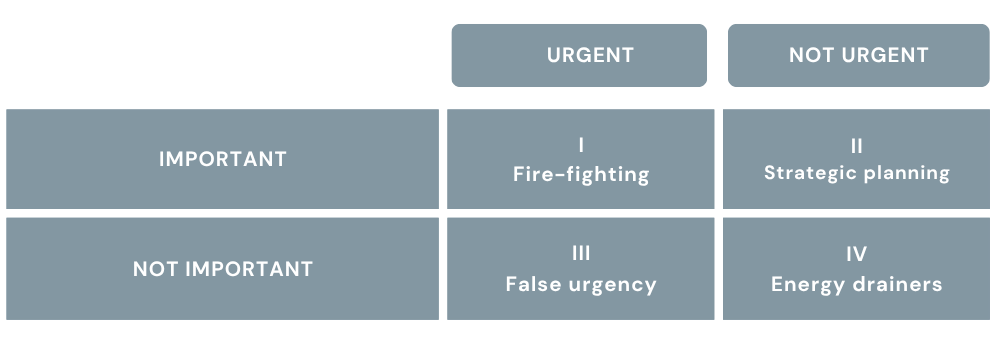
For teams, this model is incredibly valuable. It guides discussions like: Where should we invest our collective energy? and What should we delegate, hand over, or stop doing? It brings unspoken assumptions and habits to light and makes them discussable. That leads to better control of time and greater team impact.
Team Energy vs. False Urgency
In many teams, the daily grind dominates. Everyone is busy, but no one seems to be moving in the right direction. Many so-called “urgencies” turn out to just be loud – not truly important. A client demanding something by tomorrow? A quick follow-up often reveals that next week is just fine. By raising team awareness about false urgency, you free up time for what really matters. This creates space for strategic thinking and creative solutions. Teams that learn to recognize this become both more effective and more resilient.
Managing the Quadrants as a Team Skill
Teams that consistently perform well avoid quadrant III (not important but urgent) and quadrant IV (not important and not urgent). They focus their energy on quadrant II – the area where growth, development, and strategy are born. Think of launching learning paths, driving innovation, giving each other feedback, and taking time to reflect. By anchoring this way of working, forward thinking becomes the norm rather than reacting to the moment. That’s the difference between merely surviving and sustainably performing.
Create Space for Real Focus
In an age where we often work in open-plan offices or connect remotely, focus requires conscious choices. A team that truly wants to move forward protects its energy sources. That could mean scheduling offline time, turning off notifications, or organizing a shared “deep work” day. Creating space for focus starts with collectively recognizing priorities. Without space, there’s no creativity – and without creativity, no innovation. So focus isn’t a luxury – it’s a necessity for any team that wants to grow.
Make Fire Prevention a Team Strategy
Important and urgent tasks – the fires – will always be part of the job. But successful teams invest in fire prevention. They consciously make time for reflection, strategy, and collaboration. That way, not everything has to be ad hoc, and the team grows in calm, control, and results.
“The key is not to prioritize what’s on your schedule, but to schedule your priorities.”
– Stephen Covey
So: stop procrastinating, make development a team priority, and work together on building sustainable energy. Because a team that makes conscious choices keeps moving – in the right direction. Real progress starts with making decisions – not based on pressure, but on purpose. That’s how work becomes energizing again, instead of draining.
